
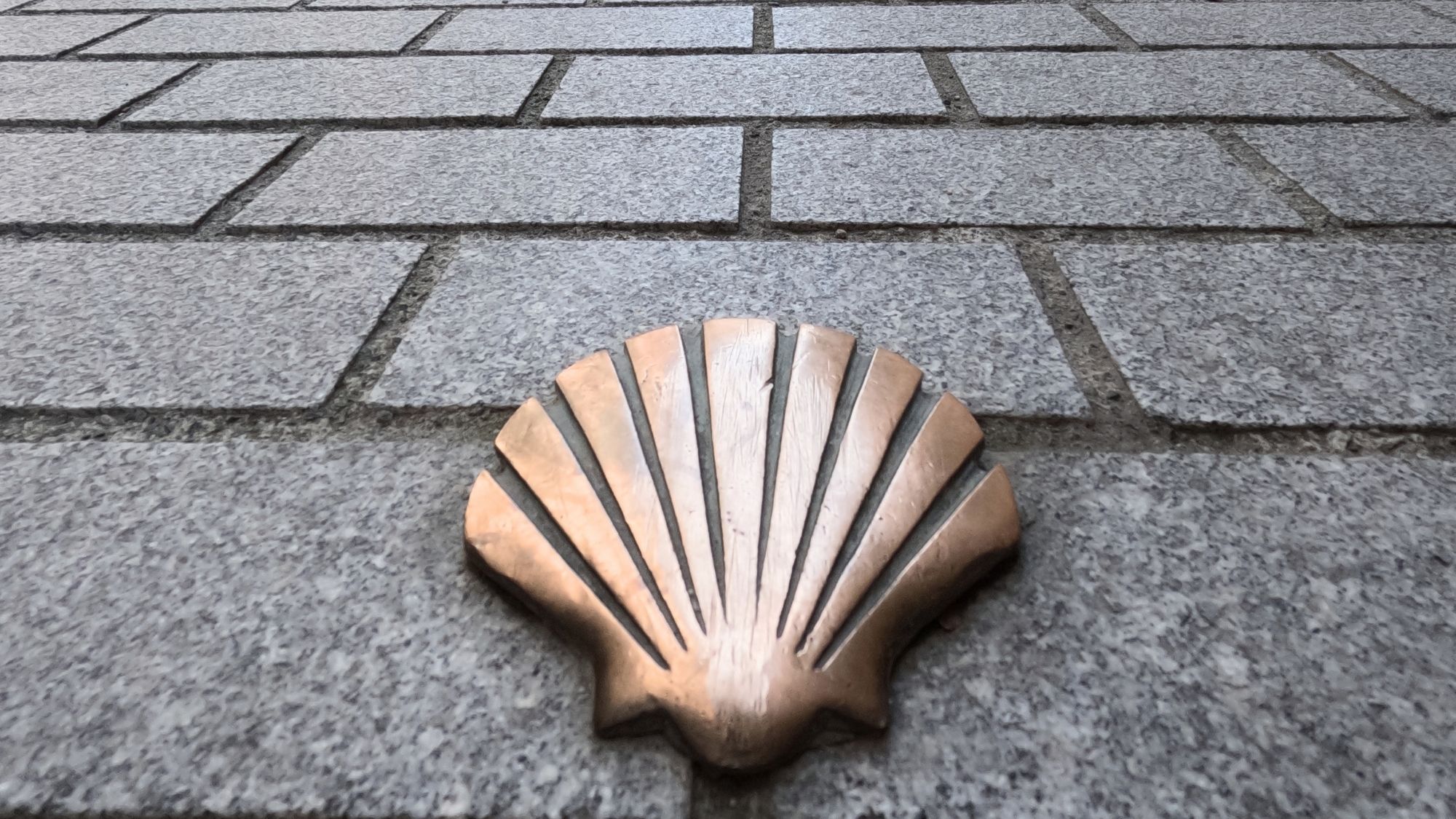
When I was planning my first Camino adventure, I imagined one route, stretching from the French Pyrenees to the Spanish coast. There was a lot less information about the Camino back then. But when I started walking and met other pilgrims, I soon realised that the Camino de Santiago is a collection of routes.
In medieval times, pilgrims would traditionally begin walking from their own front door, so the starting point for the Camino could be literally anywhere. These days, the waymarked routes can start as far west as Budapest, or as far north as Trondheim.
With such an extensive network to choose from, how do you decide which route to take?
To make choosing a little easier, let’s start by looking at the most popular and well-established Camino routes.
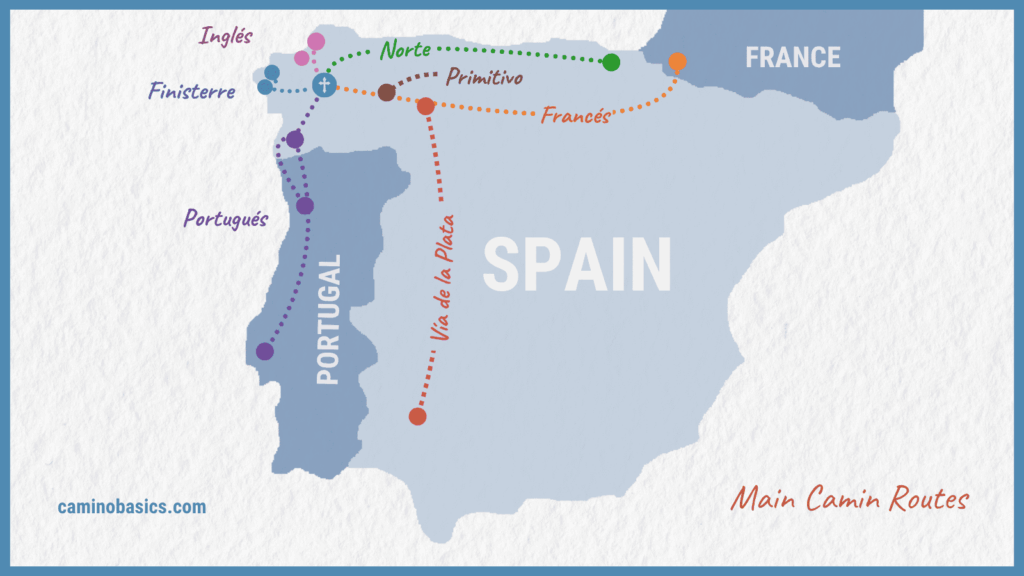
The Main Camino Routes
According to the Pilgrims Reception Office, most pilgrims make their journey to Santiago via one of the following routes:
- Camino Francés (The French Way)
- Camino Portugués (The Portuguese Way)
- Camino del Norte (The Northern Way)
- Camino Primitivo (The Original Way)
- Camino Inglés (The English Way)
- Vía de la Plata (The Silver Way)
A Quick Introduction to the Popular Routes
To give you a feel for these different Caminos, here is a brief introduction to the main routes:
Camino Francés
The Camino Francés is the most well-known and popular of the Camino routes. This classic trail passes through the regions of Navarre, La Rioja, Castilla y León, and Galicia. Over the years it has been the inspiration for numerous books, films, and documentaries. For new pilgrims it offers history, culture and a sense of community. It was my first Camino, and remains my favourite route.
Camino Portugués
This route starts in Lisbon and heads north through Portugal towards Santiago de Compostela. Growing in popularity over the past decade, this route has now become one of the most popular Camino trails. It offers Central and Coastal variations with the option of a shorter Camino starting from either Porto or Tui.
Camino del Norte
The Camino del Norte follows Spain’s coastline through the Basque Country, Cantabria, Asturias, and Galicia. Established in medieval times by pilgrims arriving via the northern ports, it is one of the longer and hillier routes.
Camino Primitivo
Known as The Original Way, the Primitivo is believed to be the first pilgrimage route to Santiago. The trail starts in Oviedo and crosses the mountains before joining the Camino Francés. Although it is one of the shorter Caminos, it is also considered one of the most challenging.
Camino Inglés
This is one of the shortest and most direct routes to Santiago. The Camino Inglés has two starting points: A Coruña and Ferrol. Shaped like a Y, the two branches cross the Galician countryside and come together before the final stretch to Santiago.
Vía de la Plata
Beginning in Seville, this route travels almost 1,000 km north. The trail passes through Andalucía, Extremadura, Castilla y León, and Galicia. It is one of the longest, hottest and most challenging routes.
ℹ️ Want more information on individual routes? Check out my mini-guides, or head over to the Guidebooks and Apps page for links to useful resources.
Why Choose a Popular Route?
In addition to the main routes listed above, there are other less popular trails and extensions you could explore.
However, for your first Camino, I would recommend sticking to one of the well-established trails. There are clear benefits to hiking one of the popular routes, which include:
- Sufficient accommodation
- More frequent waymarking
- Availability of guidebooks and mobile apps
- The company of fellow pilgrims!
How to Choose the Right Camino Route for You
Choosing the best route for your first Camino will depends on several factors. You’ll want to consider how much time you have available, how busy you want it to be and what kind of weather you’re comfortable walking in.
⌛ How Much Time Do You Have?
Once you have decided how much time you have available for your trip, you can narrow down your options to routes that fit within that timeframe.
How long it takes you to complete each trail will depend on your walking pace and the length of your stages. Looking at the average walk times for individual routes will show you what can be achieved in the time available.
Some of the longer routes can take several weeks to complete. For example, the Camino Francés from Saint-Jean-Pied-de-Port to Santiago de Compostela takes, on average, 5 weeks. So, if you are up for a big adventure, go for it!
If time is limited, split one of the longer routes into week-long sections, or start a little closer to Santiago. Alternatively, opt for one of the shorter routes like the Camino Inglés and embark on a great mini pilgrimage.
📝 Want to compare distances and average walk times? Download your free Camino Planning Starter Pack, which includes a distances comparison table with average walk times from popular starting points.
🥾 How Busy Do You Want It to Be?
The Camino de Santiago has been growing in popularity and the number of pilgrims has been steadily on the rise. By the end of 2025, around half a million pilgrims had registered in Santiago to receive their Compostela.
The popular routes, although well-established, are not equally busy. There is a big difference between the numbers on the Francés and the Norte for example. If you are seeking a more solitary experience, you can still find it on one of the popular routes.
Each year, the Pilgrims Reception Office publishes data on the number of pilgrims arriving in Santiago. This offers some insight into how busy each route might be. The current data suggests the Camino Francés is still the most popular route, with the Portugués becoming increasingly popular.
☀️ Which Season Do You Plan to Go?
The main season for the Camino de Santiago spans from April to October. However, each Camino will have its own optimal window for walking, so you may want to consider this when choosing your route. Most routes can be undertaken year-round, except for Vía de la Plata, which should be avoided during the hot summer months due to high temperatures.
Spring
This can be one of the best times of year to walk the Camino, when the weather is getting warmer, and wildflowers are in bloom. The Galician routes like the Camino Inglés or Camino Finisterre are good options for this time of year. However, the region’s microclimate means you can expect rain whatever the season, so pack your waterproofs!
Summer
This is the optimal season for the coastal routes like Camino del Norte or Camino Portugués. The weather is more stable at this time of year, with less risk of storms and strong winds coming in from the Atlantic. The Camino Francés is popular in the summer, but its central plateau (the Meseta), is notorious for its very hot and dry conditions.
Autumn
This season is becoming increasingly popular for all Camino routes, probably due to rising temperatures and heatwaves throughout the summer months. It is an ideal time to undertake the Portugués or the Francés but be aware that both routes are still likely to be busy. By late autumn, the Vía de la Plata starts to become a possibility, depending on temperatures.
Winter
The best option for a winter Camino is the Camino Francés. Its extensive infrastructure means this route can be walked year-round. However, winter conditions can be more challenging, and some accommodation may be closed – so more research and planning will be required. Mountainous areas like the Pyrenees, Montes de León, and O Cebreiro should be avoided at this time of year because of snowfall.
Your Camino Experience
Before you decide on a route, it’s worth considering what you want from your pilgrimage. Different trails will deliver different experiences. Do you want time alone for reflection, or are you keen to connect with others? Do you want to take it slow and steady, or challenge yourself with something more strenuous?
Connection and Community
The busiest trails offer the best opportunities to connect with like-minded people. If you want a sociable experience, the classic Camino Francés may be the route for you. You might find yourself part of a Camino family as you encounter the same pilgrims at different points along the way, forming connections that can lead to lasting friendships.
Challenging Adventure
If you are seeking a challenge, then the hilly terrains of the Camino Norte or Primitivo will put your legs and lungs to the test. Less crowded than the Francés, it’s possible to find solitary stretches with the feel of a big solo adventure! The Vía de la Plata is the longest Camino route in Spain and has some tough terrain. If you are up for a long-distance challenge and can handle the heat, then the Vía de la Plata may be one to consider.
Mini Pilgrimage
The shorter routes are a great option if you have limited time or if you want a taste of the Camino experience without committing to a longer trip. The Camino Inglés or Camino Finisterre will allow you to complete your pilgrimage in less than a week. If you start from Ferrol on the Camino Inglés, you can clock up the minimum 100 km required to collect your Compostela in Santiago.
Do You Want to Continue to Finisterre or Muxía?
Many pilgrims arrive in Santiago and realise they are not quite ready to finish their Camino.
Having achieved your goal of reaching Santiago, you may feel like you need time to reflect on the experience. A trip to Finisterre can offer the time and space to do this.
The Camino Finisterre is a short route that starts at the cathedral in Santiago de Compostela and stretches approximately 90 km across the rolling hills of Galicia to Cape Fisterra on the west coast of Spain. It takes on average 3-4 days to complete, with stages between 20 and 35 km.
The lighthouse at Cape Fisterra is where the 0.00 km waymark is located, and for many pilgrims, this represents a meaningful end to their journey.
For those who want to extend it further, it is also possible to add an extension to the fishing port of Muxia – this will add an extra day and an additional 29 km to the journey.
If you choose to walk from Santiago to Finisterre, you will be eligible for an additional certificate called the Fisterrana. If you also include Muxía, you can collect the Muxiana certificate. To learn more about the Camino Finisterre, you can check out my mini guide.
I hope this article has helped you explore the different route options for your first Camino. Now you have an idea about which route you want to walk, it’s time to get planning! Head over to Camino Planning to check out more useful articles and practical tips to help you prepare for the journey.
Still not sure which route is right for you?
📝 Download your free Camino Planning Starter Pack including a Route Comparison Guide, making it easy to compare the main Camino routes at a glance.