
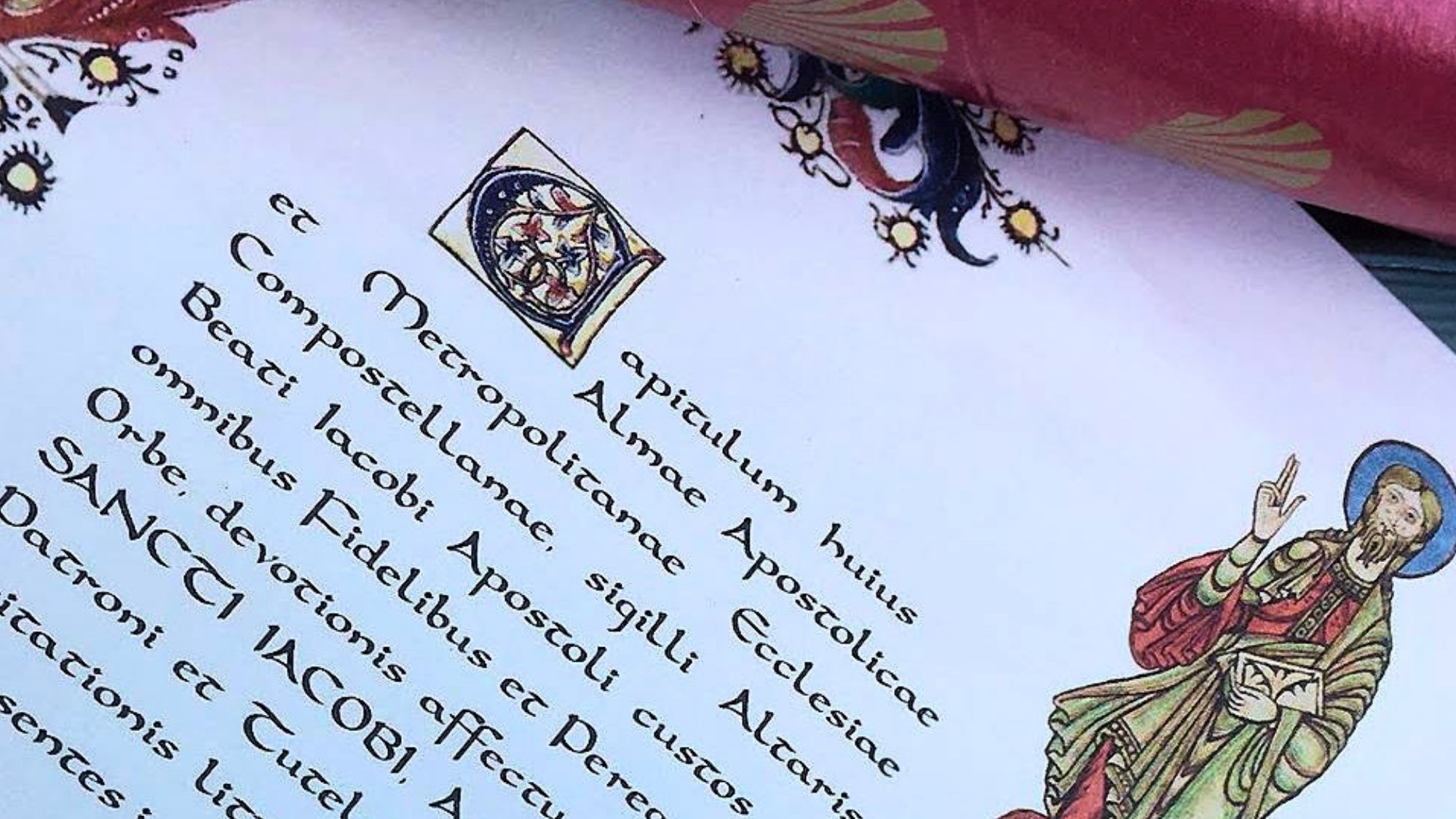
Arriving at the cathedral in Santiago typically marks the end of an incredible journey, and collecting your Compostela is an important part of celebrating that achievement.
So, what exactly is the Compostela, and how do you get one?
What Is the Compostela?
The Compostela is the traditional certificate of achievement issued by the Pilgrim’s Office in Santiago to those who have travelled the Camino.
A Little History
Shortly after the Camino de Santiago became popular (in around the Middle Ages) it became necessary to find an official means of certification for pilgrims.
The earliest proof of pilgrimage was a scallop shaped badge issued to pilgrims upon arrival in Santiago. But because these badges were easy to forge, the church had to introduce penalties to prevent fraud and create a new (more secure) system.
Letters of proof called Cartas Probatorias were introduced in the 13th century and evolved into what is now known as the Compostela.
In the 16th century the Hostal dos Reis Católicos was founded. Located close to the Cathedral, the building served as both a hostal and hospital for pilgrims arriving in Santiago.
In 1953 it underwent renovation and re-opened as a hotel. It now operates as one of Spain’s Paradores (luxury hotels). In keeping with the tradition of caring for pilgrims, the hotel still offers 10 free meals to the first few pilgrims arriving in Santiago each day on presentation of their Compostela.
The Certificate
The Compostela can make a beautiful keepsake. The certificate is printed on parchment paper, with the text in Latin.
The English translation is as follows:
The Chapter of this Holy Apostolic and Metropolitan Cathedral of Compostela, custodian of the seal of the Altar of St. James, to all the Faithful and pilgrims who arrive from anywhere on the Orb of the Earth with an attitude of devotion or because of a vow or promise make a pilgrimage to the Tomb of the Apostle, Our Patron Saint and Protector of Spain, recognises before all who observe this document that: …………… has devotedly visited this most sacred temple having done the last hundred kilometers on foot or on horseback or the last two hundred by bicycle with Christian sentiment (pietatis causa).
In witness whereof I present this document endorsed with the seal of this same Holy Church.
Issued in Santiago de Compostela on ……… of …………… year of our Lord ……….
The Dean of the Cathedral of Santiago.
(Translation from the Pilgrim’s Office website)
Note: When issuing your certificate, they will often Latinise your name. So, for me it became Helenam. Pretty cool… once I’d worked out it wasn’t a typo!
Compostela Eligibility
To receive the Compostela, your pilgrimage must meet specific criteria.
You must:
- Have made your pilgrimage for religious/spiritual reasons.
- Have travelled at least 100 km by foot or on horseback (200 km by bike).
- Have travelled at least 70 km within Spain (if starting from another country).
- Have travelled an official route, recognised by the Pilgrim’s Office, with the final stage ending at the Cathedral in Santiago de Compostela.
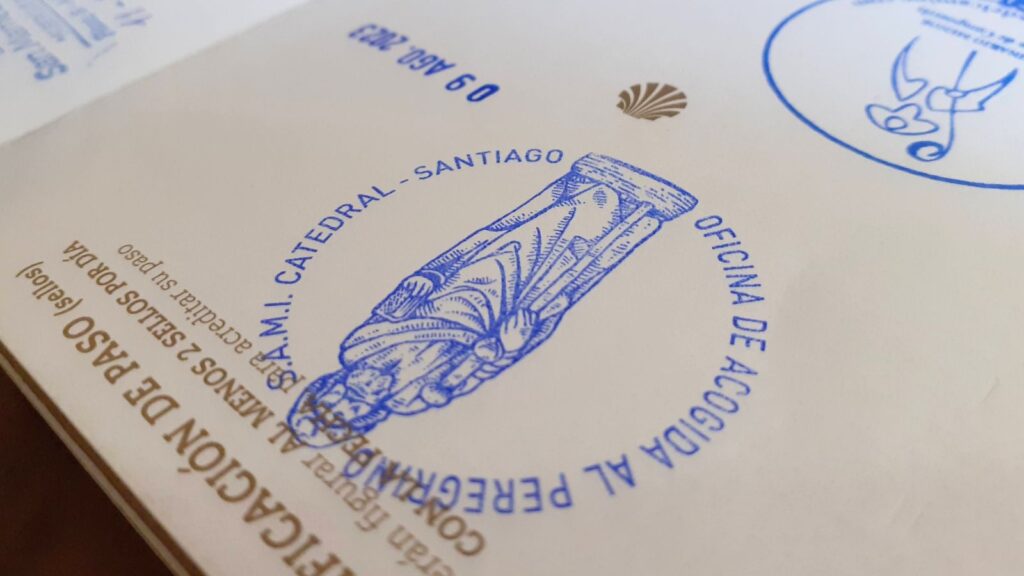
- Have collected stamps along the way in your Pilgrim’s Passport as proof of distance travelled.
The Pilgrim’s Passport and Stamps
Also known as a Credencial, a Pilgrim’s Passport is a small booklet in which you collect stamps at various points on the Camino. It acts as proof of your pilgrim status and must be presented in order to stay at the official Pilgrim’s Hostels on route.
You can obtain the stamps (sellos) for your passport at various establishments along the route. Places related to the Camino are preferred by the pilgrims Office i.e. churches, cathedrals, pilgrims’ hostels, etc. but stamps can also be obtained at bars, cafes, and hotels.
To qualify for the Compostela, you must collect two stamps per day during the last 100 km (200 km by bicycle) at the start and end point of each stage.
Note: The Pilgrim’s Office also states that the route can be completed in sections (for example 4 x one week trips). However, it must be done in chronological & geographical order and the Pilgrim’s Passport must be stamped at the start and end of each section (with dates) showing that you picked up the route where you left off.
How to Collect the Compostela
Upon arriving in Santiago, you need to go to the Pilgrim’s Reception Office to present your Pilgrim’s Passport.
The Pilgrim’s Office is now located at the following address:
Pilgrim’s Reception Office
Rúa Carretas, nº33
15705 Santiago de Compostela
A Coruña – ESPAÑA
(Open daily 9 am – 7 pm)
In recent years, the increasing number of pilgrims has sometimes led to extensive queues and long waiting times. However, a system is now in place to avoid crowding and ensure the safety of pilgrims and staff.
To collect the Compostela you will be required to:
- Pre-register via the website, which will issue you with a QR code.
- Present the QR code to the staff at the Pilgrim’s Office, who will give you a ticket.
- Wait for your number to appear on the screen and go to the relevant desk with your Pilgrim’s Passport.
Top Tips for Collecting Your Compostela
- Arrive early, queues seem to get longer as the day progresses and more pilgrims arrive.
- Make sure all your stamps have been dated.
- Ensure your personal details are filled in at the front of your pilgrim’s passport.
- Have a form of payment handy in case you wish to purchase a protective tube for your Compostela or a Distance Certificate.
The Certificate of Distance
If you are not walking the Camino for spiritual/religious reasons, it is possible to obtain a Certificate of Distance. This certificate details the start and finish date, distance covered, and route walked.
Many pilgrims purchase a Distance Certificate in addition to their Compostela as an official record detailing the specifics of their pilgrimage. The certificate costs €3, which goes towards the cost of providing services for pilgrims.
Distance Certificates can also be purchased by those who have completed their Caminos in the past by e-mailing certificadodedistancia@catedraldesantiago.es.
The Fisterrana and Muxiana
If you choose to walk from Santiago to Finisterre, you will be eligible to collect the Fisterrana, or if you are walking to Muxía, you can collect the Muxiana. You must collect two stamps per day in your Pilgrim’s Passport to qualify. Certificates can be collected from the Tourist Office in Finisterre (for the Fisterrana) and the Town Hall in Muxía (for the Muxiana).
I found collecting my first Compostela quite an emotional experience, for me it marked the end of an incredible journey. Each time I undertake a new route collecting my Compostela helps me reflect on the journey and recognise what I’ve learned and achieved.
The Compostela from my most recent trip on the Camino Francés has pride of place on my wall, reminding me each day (as cliched as this sounds) life really is all about the journey!
As well as proof of your achievement, the Compostela serves as a lovely reminder of your adventure – so don’t forget to collect those stamps in your Pilgrim’s Passport!
For more information on the Pilgrim’s Passport, check out my article: What Is a Pilgrim’s Passport (Credencial) and How Do You Get One?