
The Camino Inglés (The English Way) is one of the shortest and most direct routes to Santiago.
Possible to complete in as little as 3 days, it makes a great choice for those with limited time. For new pilgrims it can offer a taste of the Camino, without having to commit to a longer trip.
The route was established during medieval times when it was used by pilgrims arriving by sea from England and other northern European countries. Many of these maritime Pilgrims arrived at A Coruña (or other ports, including Ferrol) before continuing their journeys on foot.
Away from the crowds of the Camino Francés, the Inglés can offer a more peaceful approach to Santiago.
📋 Table of Contents
The Route
The route runs north to south across the Galician countryside, beginning on two separate trails. Shaped like a Y, the two branches eventually come together at the village of Hospital de Bruma before the final 40 km into Santiago.
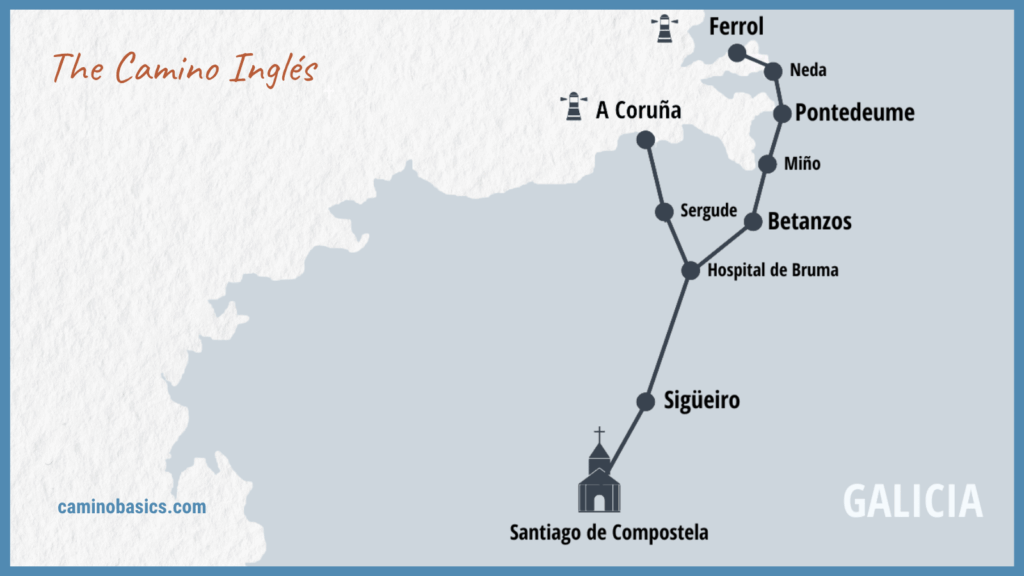
Starting from Ferrol, the route can be walked in around 5 days, covering between 15 km and 28 km per day. The route from A Coruña can be accomplished in as little as 3 days, covering between 16 km and 32 km per day.
The route from Ferrol is generally more popular and covers the minimum 100 km required to collect the Compostela in Santiago. However, the route from A Coruña can make a great alternative for a peaceful start on what is becoming one of the more popular Caminos.
The first time I walked the Camino Inglés, I started from A Coruña. It was a great mini-pilgrimage! I appreciated both the calm, reflective beginning and the company of other pilgrims on the final walk into Santiago.
The route is well waymarked on both branches. The distinctive yellow arrows (and symbolic scallop shell) mark the way on rocks, trees, and buildings along the route.
It’s also worth noting that this is one of the few routes that doesn’t converge with the Camino Francés. Which means you can usually avoid the big crowds on the final approach to Santiago.
Where to Start?
The route has two official starting points on the north-west coast of Spain:
A Coruña (73 km to Santiago)
Ferrol (112 km to Santiago)
The closest airport to both Ferrol and A Coruña is A Coruña (LCG). From the airport you can catch a bus to the city centre, and then continue on to Ferrol by train. To find the best travel options from your home country, you can use a journey planning tool like Rome2Rio.
Terrain
The route traverses the Galician countryside across rolling hills and through the region’s distinctive eucalyptus and pine forests. Underfoot, you’ll find a mixture of dirt tracks, forest paths, and a fair amount of tarmac. As with most Camino routes, there is a some road walking (particularly when entering and exiting towns and villages). The route offers beautiful views of the Galician countryside with its forest-covered hillsides, traditional villages, and historic churches.
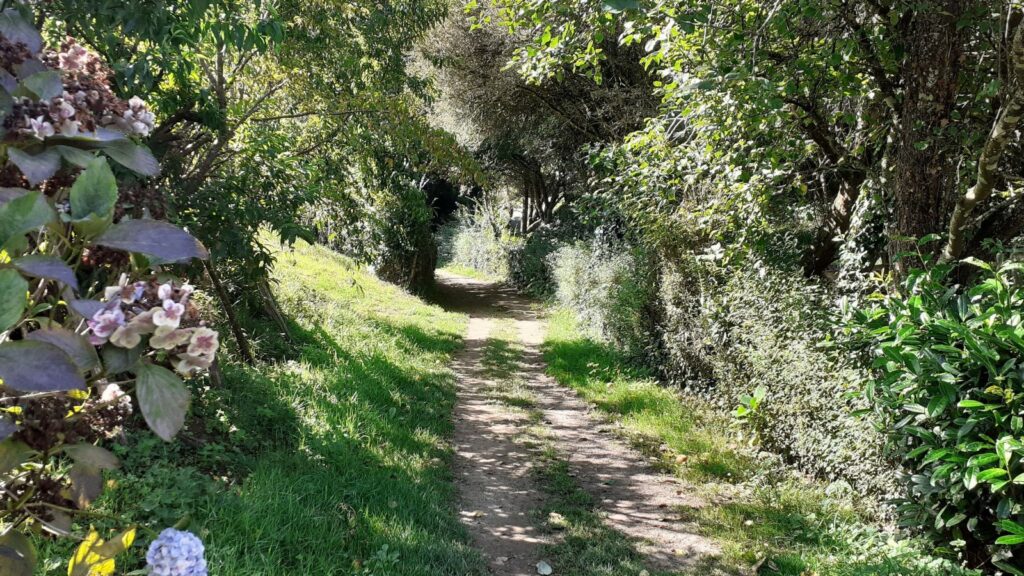
The route from Hospital de Bruma runs parallel to the main road (N-550) that joins A Coruña with Santiago. A distant hum of traffic acts as a reminder that civilisation is never far away. There are plenty of places to take rest stops, and easy access to buses and taxi services if needed.
The length of the Camino Inglés makes it one of the easier routes to accomplish. However, there are still some challenging sections. The most challenging day is the stage before Hospital de Bruma. It’s a long stretch on both branches, with a steep ascent up to the village. The final 16 km stage to Santiago is the shortest section and provides a gentler approach to Santiago.
Cities, Towns, and Villages
Cities bookend the trail, which also passes through several towns, villages and tiny hamlets. The main towns and villages along the route are:
Starting from Ferrol: Neda, Pontedeume, Betanzos, Hospital de Bruma, and Sigüeiro.
Starting from A Coruna: Sergude, Hospital de Bruma, and Sigüeiro.
The coastal cities have all the facilities you’d expect from large urban centres. Ferrol has a modern feel and is famous for its naval port. A Coruña has a grand central square, an attractive old town, and an impressive Roman lighthouse called the Tower of Hercules.
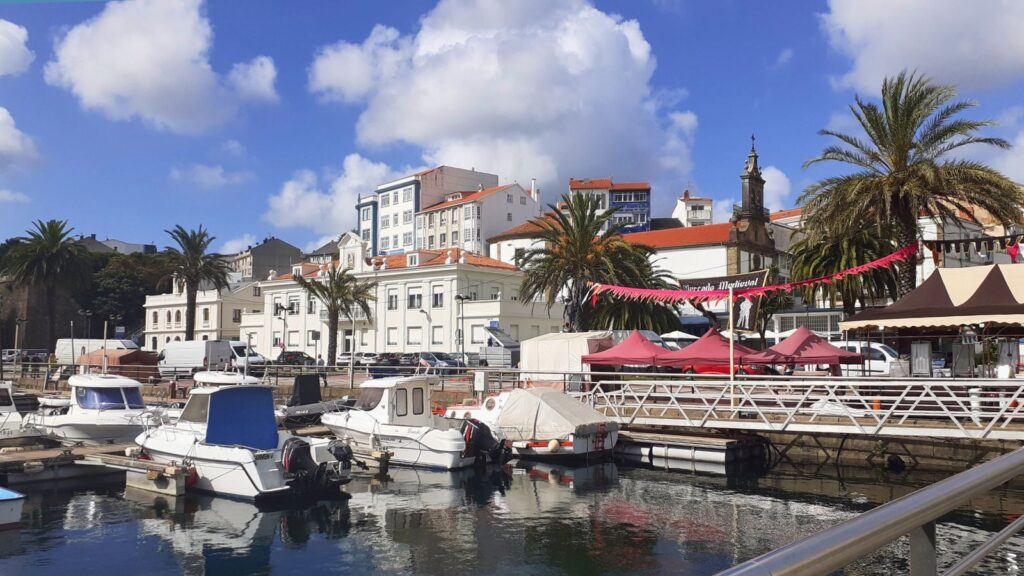
Both starting points offer plenty of opportunities for eating out. The Plaza de Maria Pita in A Coruña has several restaurants, with tables spilling out into its very grand central square. Bars offer light meals, tapas and irresistible sweet treats like chocolate con churros. You will find seafood featured on the menu of Ferrol’s numerous restaurants, including cockles, clams, scallops and crab.
The branch starting from A Coruña is more rural and passes through smaller villages and settlements. The branch from Ferrol offers a little more in terms of culture and sightseeing, passing through some notable historic towns including Pontedeume and Betanzos.
What to See?
Crossing the bridge into Pontedeume, pilgrims are greeted by the town’s attractive waterfront – with some very inviting restaurants and bars! Wander up into the centre, and you’ll discover cobbled streets and traditional buildings.
With its attractive historic centre, the town of Betanzos is also worth exploring a little. If you arrive early (and have the energy), you could spend an afternoon wandering the medieval streets, visiting one of its Gothic churches, or sampling its famous local tortilla.
Although there may be fewer sightseeing opportunities on the branch from A Coruña, it does pass through some lovely rural settlements. Along the route, you will encounter churches, traditional stone crosses and fountains.
Once arriving at Hospital de Bruma (where the branches merge) you will also come across the Chapel of San Lourenzo on the site of where a medieval pilgrims’ hospital once stood.
When to Go?
April to October is recommended. The route is becoming more popular, but it is still much less frequented than the Camino Francés, particularly on the branch from A Coruña. Spring is quieter with fewer pilgrims, and the weather is cooler. With Galicia’s microclimate, rain should be expected at any time of the year. Summer is usually hot, with smaller albergues filling up more quickly.
Accommodation
Accommodation is more limited than on the Camino Francés. However, it is still sufficient, and more options seem to be popping up as the route grows in popularity.
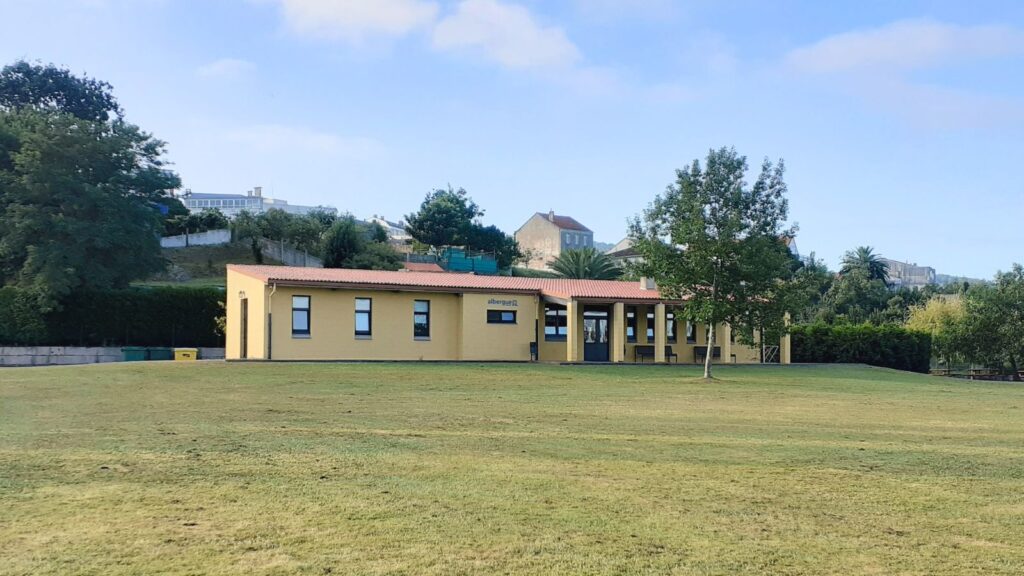
Municipal albergues are located at Neda, Pontedeume, Miño, Betanzos, and Hospital de Bruma. These pilgrim hostels are the cheapest and most basic type of accommodation, dormitory-style (usually bunk beds), they cannot be booked in advance and offer priority to pilgrims making the journey on foot.
Private albergues are also available, and with the route becoming more popular, several new ones have sprung up over the past few years. With many offering private rooms and additional facilities such as washing machines and tumble dryers. They are more expensive than municipals but usually allow bookings in advance. Alternative accommodation is available in the larger towns and cities in the form of Hostales or Hotels.
Some accommodation is also available between the main towns and villages. So, if you want a more relaxed Camino, you could split some of the longer stretches.
As the route increases in popularity, there is more demand for accommodation (particularly where the 2 branches converge Hospital de Bruma). With this in mind, it may be worth pre-booking where possible to avoid getting caught up in a race for beds.
If you are seeking a Camino that fits nicely into a weeklong holiday, the Camino Inglés can make a great mini pilgrimage. From coast to city, through the beautiful Galician countryside, both easily accessible and well waymarked, it can be a great option for a first Camino.
Further Planning
Want to walk the Camino Inglés? Then it’s time to get planning.
If you’d like more detailed information on the individual stages, check out the Xunta de Galicia’s page on the Camino Inglés which is an excellent resource.
For more practical tips and advice on how to get started, including packing, budgeting and stage planning, continue exploring here on Camino Basics.