
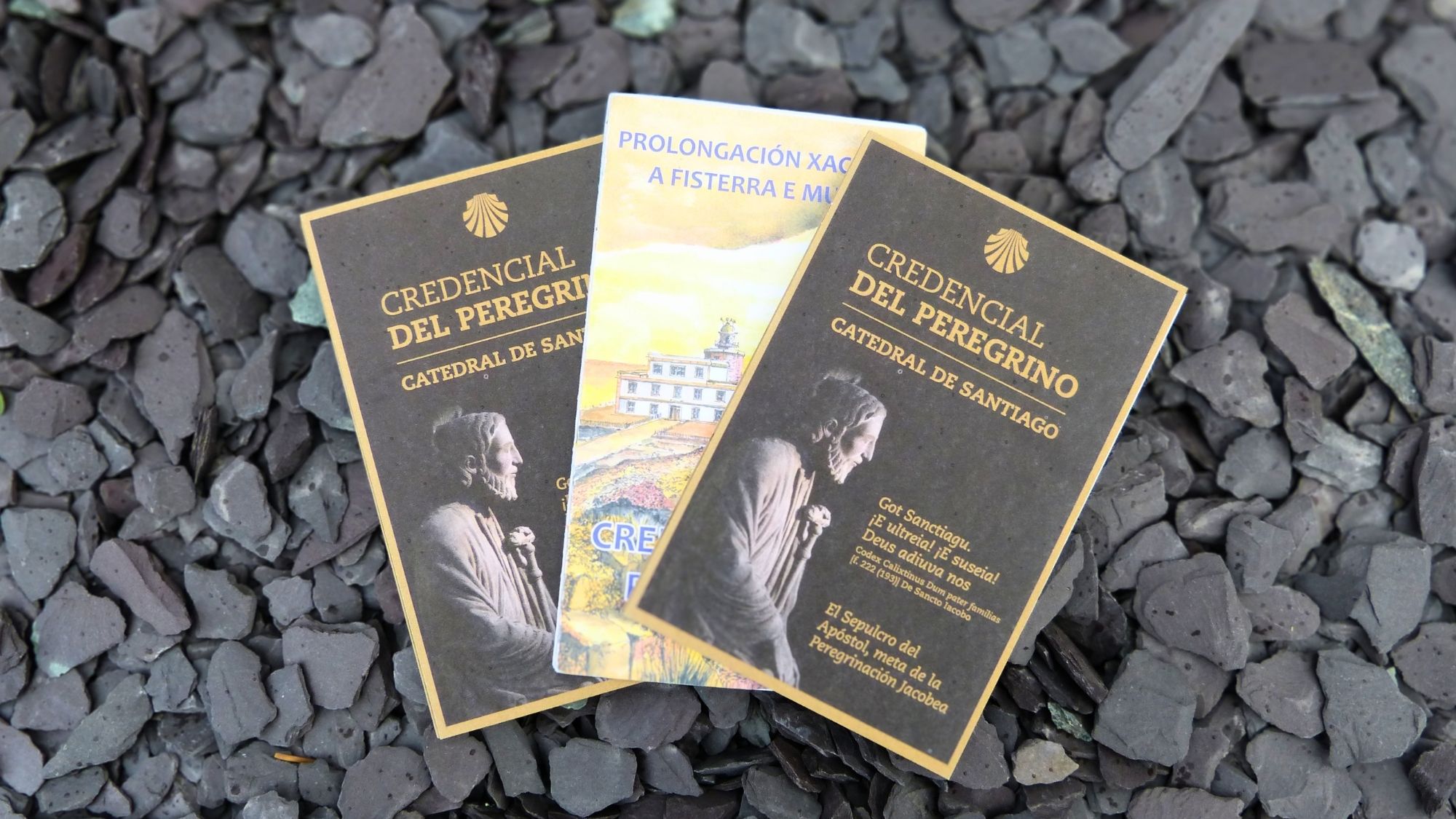
One item you’ll want to keep close to you on the Camino de Santiago is your Pilgrim’s Passport.
Its colourful stamps will remind you of all the wonderful places you’ve passed through! However, this important document is much more than just a souvenir of your journey.
What is a Pilgrim’s Passport?
Officially known as a Credencial, a Pilgrim’s Passport is a small booklet in which you collect stamps at various points on the Camino. It proves your pilgrim status and grants you access to stay at the official Pilgrim’s Hostels along the route.
The Pilgrim’s Passport (issued by the Pilgrim’s Office in Santiago) is a concertina-style booklet printed on thin card. It consists of 16 pages (not including the front and back cover):
- The first page is for the completion of the pilgrim’s details and has 2 spaces for stamps (one from the place of issue and another for the final stamp from the Cathedral in Santiago).
- The second page outlines both the purpose of the Credencial and eligibility for the Compostela.
- On the back there are maps of various Camino routes.
- The back cover includes a blessing from the Codex Calixtinus and the Pilgrim’s Prayer.
- There are 6 pages with spaces available for you to collect stamps.
Note: The format may differ a bit if your Pilgrim’s Passport has been issued by your local Pilgrims Association, as some are authorised to distribute their own Credencials by the Cathedral in Santiago de Compostela.
Why You Need a Pilgrim’s Passport
The Pilgrim’s Passport has 2 main functions: Firstly, to identify you as a Pilgrim, so you can gain access to the dedicated Pilgrim’s Hostels on route, and secondly to prove your eligibility for the Compostela Certificate.
In the Pilgrim’s Passport it states that the Credencial is for:
‘Pilgrims on foot, bicycle or horseback, who wish to make the pilgrimage with a Christian sentiment, even if it is only with an attitude of search.’ (Translation from the Pilgrim’s Office website).
You don’t need to be a Christian to walk the Camino, or to carry a Pilgrim’s Passport. People walk the Camino from a variety of backgrounds and for numerous motivations. However, to be eligible for the Compostela, you will need to declare that you have walked the Camino with an intention that is either religious or spiritual in nature (not purely for reasons of tourism).
How to Use Your Pilgrim’s Passport
The first step is to make sure all your details are completed on the first page. This is usually done at the place of issue, but if ordering your Pilgrim’s Passport in advance you may need to complete these details yourself.
When you stop for a break or arrive at your accommodation at the end of the walk, simply present your Credencial and ask if they have a stamp. The word for stamps in Spanish is Sellos, you could use the phrase:
¿Tienes un sello? (Do you have a stamp?).
Learning a few key phrases will enhance your experience, but simply presenting your Pilgrim’s Passport is usually sufficient to communicate this. They will either stamp and date it for you, or direct you to an area you can stamp it yourself.
I’ve noticed with the increase in numbers over recent years, more places are allowing Pilgrims to stamp their own passports, particularly in busy bars/cafes.
When you arrive in Santiago you will need to present it at the Pilgrim’s Reception Office to collect the final stamp and collect your Compostela.
Collecting the Stamps
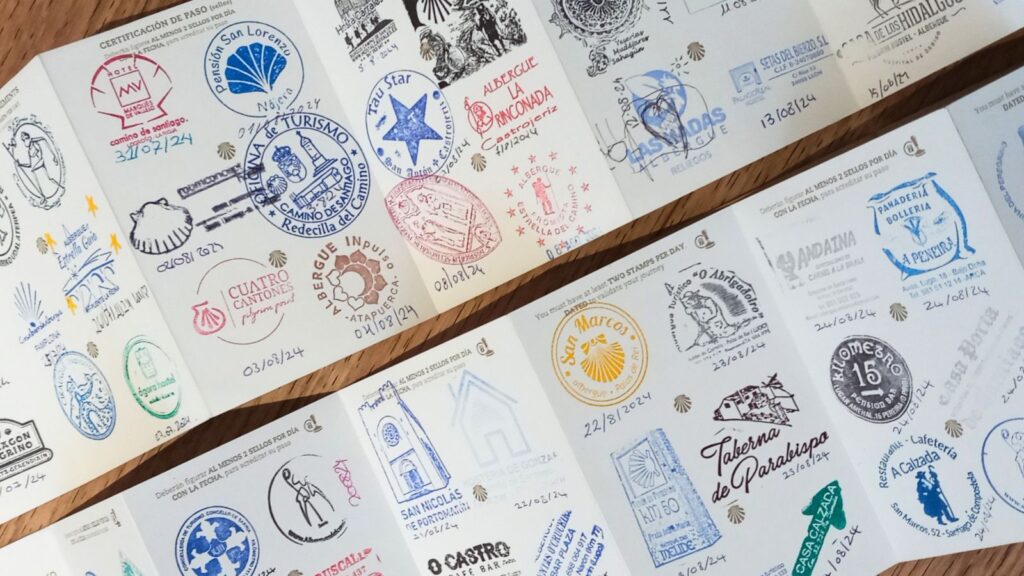
You can obtain the stamps from various establishments along the route. The Pilgrim’s Office states that places related to the Camino are preferred, i.e. churches, cathedrals, pilgrims’ hostels, etc. However, they will also accept stamps obtained at bars, cafes, and hotels.
With many places having unique, beautifully designed stamps, your Pilgrim’s Passport can make a great keepsake. My passport from my first Camino became as important to me as my Compostela. It was a wonderful record of the journey, with memories attached to each stamp.
Where Can You Get One?
You can collect a Pilgrim’s Passport once you arrive at one of the major towns or cities on the Camino.
If arriving at St-Jean-Pied-de-Port for the Camino Francés, head to the Pilgrims Information Office SJPP on Rue de la Citadelle. Where you can collect your Pilgrim’s Passport and get your first stamp.
It’s also possible to obtain them at shops or churches along the route. However, you must ensure you use an official Pilgrim’s Passport issued by your local association or the Pilgrim’s Office in Santiago to receive the Compostela.
To save the hassle of sorting it out on arrival you can also order a Pilgrim’s Passport in advance from your local Pilgrim’s Association.
In the UK you can obtain one for £6 (as a non-member) from the Confraternity of St James (Free to members).
In the US you can obtain one for $5 (as a non-member) from the American Pilgrims on the Camino (Free to members).
Official Pilgrim’s Passports can also be ordered online from the Camino Forum Store for a minimum donation of €3.
What’s a Digital Pilgrim’s Passport?
Back in January 2021 the Pilgrim’s Office launched a digital Credencial. The idea was that Pilgrims would be able to collect stamps by scanning QR codes via an app on their phone.
This implementation of technology was accelerated by the COVID-19 crisis, and it was hoped the app would reduce contact, helping to keep everyone safe during the pandemic.
However, as of 2026, the app no longer appears to be available. The traditional paper Credencial still rules and is still required to receive a Compostela at The Pilgrim’s Office in Santiago.
Tips for Using Your Pilgrim’s Passport
- Make sure to collect at least one stamp per day from the start of your Camino. Get into the habit of always presenting it at your accommodation.
- During the final 100km, you must collect at least two stamps per day to qualify for the Compostela.
- Make sure you keep a pen handy, so when required to stamp your own passport you can complete the date.
- If you plan on collecting lots of stamps, or are walking a longer route, get a second Credencial in advance.
- If your passport doesn’t come with a sleeve, it’s worth getting one to protect it. Passports can get pretty battered after a month in your backpack!
I remember receiving my Pilgrim’s Passport for my first Camino – it was from my local confraternity and the design was pretty unique. By the end of my journey, I’d fallen in love with the tattered yellow cover, its fancy lettering and hand-drawn design. It symbolised for me a great adventure and personal achievement.
Getting your Pilgrim’s Passport is an essential (and exciting) part of preparing for your journey!
Ready to start putting together the rest of your Camino kit? Wondering what else you need to pack? Get started by downloading your FREE Camino Packing List.