
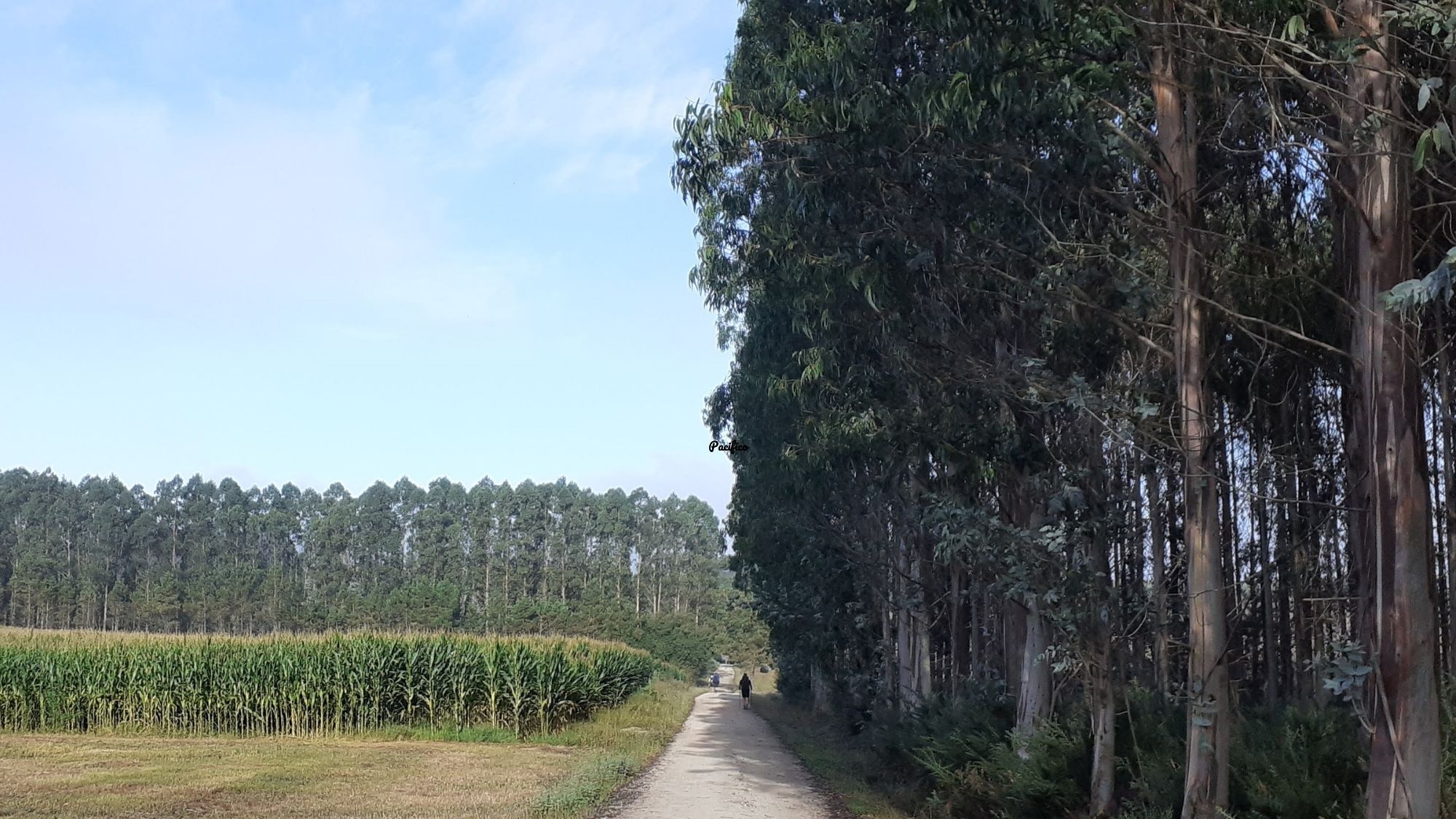
To get a rough idea of how long it takes to walk the Camino de Santiago, let’s look at the Camino Francés – the most popular of the Camino routes. Most guidebooks split this route into around 33 stages varying in length from 18-32 km per day, Add on a couple of days for travelling and you’ll be looking at around 5 weeks for your entire trip.
That’s if you follow the guidebook stages… and everything goes to plan.
However, things don’t always go to plan on the Camino, and it can be really disappointing to realise that you haven’t allowed enough time to make it to Santiago. (I know, this happened to me twice!) I recommend taking some time to consider all the factors might influence the duration of your trip before making any travel arrangements.
How long it takes you to walk the Camino de Santiago will largely depend on the following:
Which Route Do You Want to Walk?
Ok, this seems like a pretty obvious one… the Camino of course!
However the Camino de Santiago isn’t a singular trail, it comprises a whole network of routes varying in both length and difficulty. Therefore, your route choice will be the most significant factor in determining the length of your trip – some Caminos can be walked in under a week, whilst others take a month (or more) to complete.
Typical Camino Distances
| Camino | Starting Point | Distance (km) | Stages (Days) |
|---|---|---|---|
| Camino Francés | Saint-Jean-Pied-de-Port | 780 | 33 |
| Camino Inglés | Ferrol | 112 | 6 |
| Camino del Norte | Irún | 815 | 36 |
As you can see from the table above there is a big difference between a long route like the Camino del Norte and a short one like The Camino Inglés.
Shorter routes can make great mini-pilgrimages. Easy to complete in under a week, the Camino Inglés (or even the Camino Finisterre) are good options for those with limited time.
For a complete overview of the most well-established Camino routes, distances, popular starting points (and nearest airports) you can download my free Camino Planning Starter Pack.
How Far Do You Want to Walk?
Now you have selected a route you will need to decide how far you want to walk each day. Not everyone will be comfortable with the recommended guidebook stages (often around 25-30 km per day).
You may decide on a relaxed trip with shorter stages, or perhaps you want to challenge yourself with longer stretches. Either way, altering the length of your stages will have a significant impact on the time required for your overall trip. For example, if you decide to walk 10-15 km per day the route could take you double the time recommended by your guidebook.
If you are not sure what’s right for you, try testing it out at home. Start with shorter walks and build up gradually.
Once you’ve reached a distance you feel comfortable with, walk a couple of days in a row to see how well you manage these distances back-to-back. A hike of 30 km feels very different after you’ve done it 5 days in a row than it did on day one, so stress test your planned stages at home.
If you plan to carry all your kit, try a few walks with a full backpack. This will give you an idea of how extra weight impacts your pace and the distances you’re able to cover.
Think about the terrain too. It’s much easier to cover the distance on routes with long flat stages than on hilly routes with lots of accumulated ascent like the Camino del Norte or Camino Primitivo.
I experienced this first hand when I was relatively new to long distance hiking. I had completed the Camino Francés comfortably in 5 weeks, so when I was planning my first trip on the Camino del Norte I allowed a similar amount of time – I assumed there was very little difference in terms of overall distance.
However, I failed to account for the difference in terrain. All those hills! The route was much more challenging than I had anticipated. I was used to the long flat stretches of the Camino Francés, where you can cover a lot of ground in a few hours. I had neglected to apply Naismith’s Rule!
Naismith’s Rule
According to Naismith’s Rule you should allow 1 hour for every 5 km of distance plus 1 hour for every 600m of ascent. So, for example, 25km on the flat would take the average person around 5 hours to complete. However, add in 900m and you are looking at an extra 1.5 hours of walk time. Add in the additional breaks you need (or a slower overall speed on rocky or uneven ground) and you may find you need to shorten your stages or take additional rest days.
You can use Naismith’s Rule as a rough guide to help you calculate how long each stretch might take. However, keep in mind it doesn’t take into consideration the difficulty of descent, other aspects of the terrain and the impact of weather conditions. It’s always worth working out your own average walking pace. My preferred pace for the Camino is ‘Relaxed’ to ‘Average’ (I like to take it all in) so I would always add a bit of extra time regardless.
If you plan on walking less than the recommended guidebook stages, you’ll need to look at the accommodation options available on your chosen route. Some routes have long distances between accommodation, and you may need to consider using a taxi service to transport you to and from the trail, allowing you to split up some of the longer days.
How Many Rest Do You Need?
I would strongly recommend allowing some rest days… even if you don’t think you’ll need them!
Blisters, broken kit, lost luggage – all these things could potentially interrupt your Camino plans and throw you off schedule. If everything goes smoothly? Well, then you’ll have some extra days to relax and celebrate in Santiago at the end of your trip.
You may also want a few extra days to do some of the things you enjoy. Maybe you want to stop for a few days in one of the many interesting cities or towns along the route? or visit some historical sites, museums, and galleries?
Some of my best days on the Camino have been spent exploring the historical cities of the Camino Francés or enjoying the gorgeous sandy beaches along the Camino del Norte. The journey takes you through so many beautiful spots, it’s worth taking some time to really enjoy them, and then you can pace it out on the less interesting roadside stretches!
Sometimes rest days are necessary to prevent a minor injury turning into a major issue. Or you may need a few days to get over a cold (which can be pretty easy to pick up in crowded albergues). A little bit of self-care goes a long way on the Camino.
A big part of the Camino journey is experiencing all the surprising twists and turns along the way. Having a few rest days will take the pressure off when the unexpected occurs, and can transform a an unfortunate Camino mishap into a great story to tell.
Now you have a better idea of how long your Camino is going to take, it’s time to start getting your kit together. Check out my article What to Pack for the Camino de Santiago for tips and recommendations of what to bring along for the journey.