
The Camino de Santiago is the name given to a network of routes leading to the Cathedral in Santiago de Compostela in northwest Spain.
These historic trails became popular in the early Middle Ages as important Christian pilgrimage routes to the remains of St James, the Apostle.
Today, people from different backgrounds, cultures, and faiths choose to walk The Way. Each year, thousands make the journey for all kinds of reasons, from religious to recreational.
How the Camino de Santiago Was Born
To understand how the Camino de Santiago emerged, it helps to know a little about the history (and legend) that surrounds it.
Back in around 44 AD, Saint James was martyred in Jerusalem at the hands of King Herod. According to legend, his body was then transported in a stone boat to the northwest coast of Spain.
Saint James was buried in Galicia, and over time, his remains were forgotten about.
Then, in the early 9th century, a hermit called Pelayo, guided by some mysterious lights, discovered the tomb.
The remains were identified by the church as those of Saint James, and King Alfonso II went to visit the site. The king recognised the discovery as a miracle and ordered a shrine to be constructed.
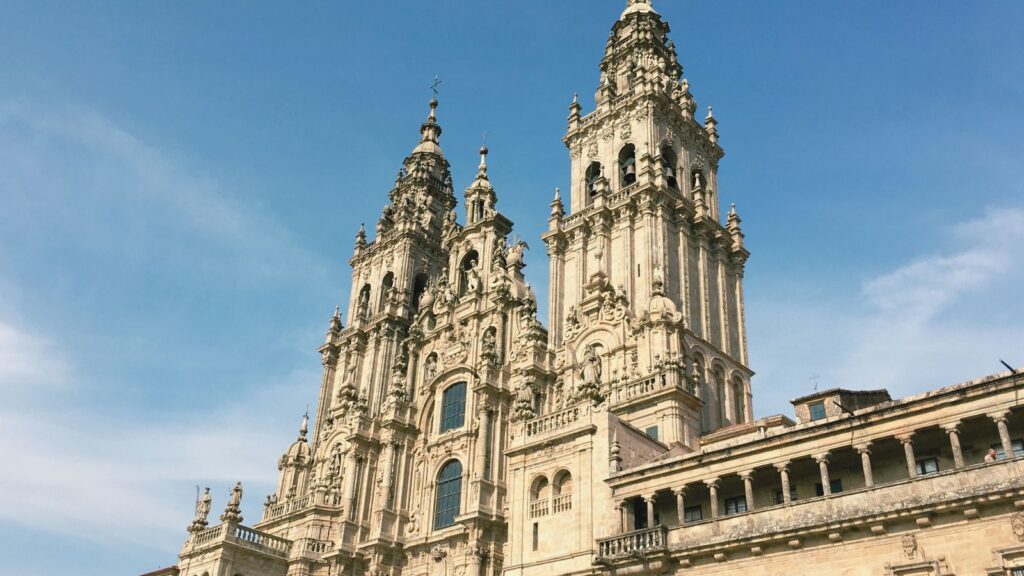
As the pilgrimage grew, the shrine was later replaced by a church. Many years later, under the reign of Alfonso VI, construction began on the present Romanesque cathedral.
The area became known as Santiago de Compostela, often translated as ‘Saint James of the Field of Stars’. Christians started to visit the remains, and Santiago gradually became a major pilgrimage destination. The Camino de Santiago (The Way of Saint James) was born.
The Camino Today
Despite its popularity during the Middle Ages, numbers gradually declined. Fast-forward all the way to the 1980s, and just a few hundred pilgrims were registering as having completed The Way.
However, in 1993, the routes of northern Spain were granted UNESCO World Heritage status and experienced a gradual resurgence in popularity.
Today, hundreds of thousands walk the Camino each year, and the numbers continue to rise.
Although the Camino remains an important religious pilgrimage, it now attracts hikers from all over the world who walk it for a variety of reasons.
Some undertake the journey for the adventure or as a personal challenge. Others seek time away from busy lives for reflection or to recover after major life changes.
In a modern world, where it’s easy to become overwhelmed, the Camino appears to be needed more than ever, and its popularity continues to be driven by the many inspiring films, documentaries, and books that place it back into the forefront of our awareness.
There’s More Than One Way to Santiago!
The Camino de Santiago is not just a singular trail, but the name given to a collection of routes that lead to the Cathedral in Santiago de Compostela.
The Main Camino Routes
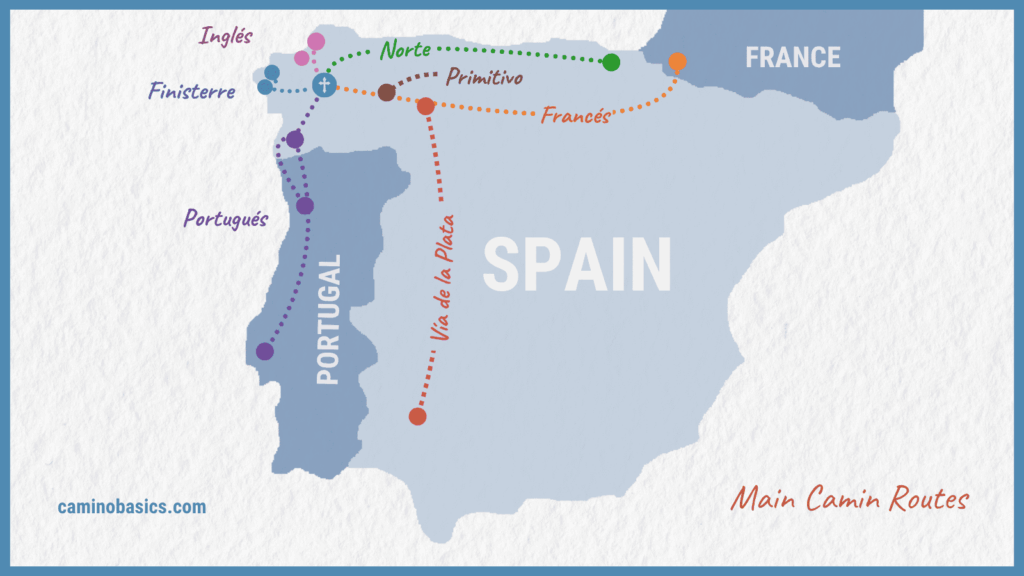
Most pilgrims choose to make their way to Santiago on one of the following routes:
- Camino Francés (The French Way)
- Camino Portugués (The Portuguese Way)
- Camino del Norte (The Northern Way)
- Camino Primitivo (The Original Way)
- Camino Inglés (The English Way)
- Vía de la Plata (The Silver Way)
There are numerous other trails and variations that lead to Santiago. However, most first-time pilgrims choose one of the well-established routes because of the infrastructure available to support pilgrims.
The popular routes can have clear advantages, including more choice of accommodation, sufficient waymarking and the availability of guidebooks and apps to assist with route-finding.
The Camino Francés
By far the most well-known (and popular) of the routes is the Camino Francés. With its well-marked trail and excellent infrastructure, it makes a great choice for first-time pilgrims. In fact, most pilgrims registering in Santiago have arrived there via this route, with many of them joining at Sarria for the last 100km.
What Is a Pilgrim?
Historically, the word pilgrim has been used to describe a person who travels to a sacred place for spiritual or religious reasons. These days, travellers on the Camino de Santiago (regardless of motivation) are commonly called pilgrims.
The Scallop Shell
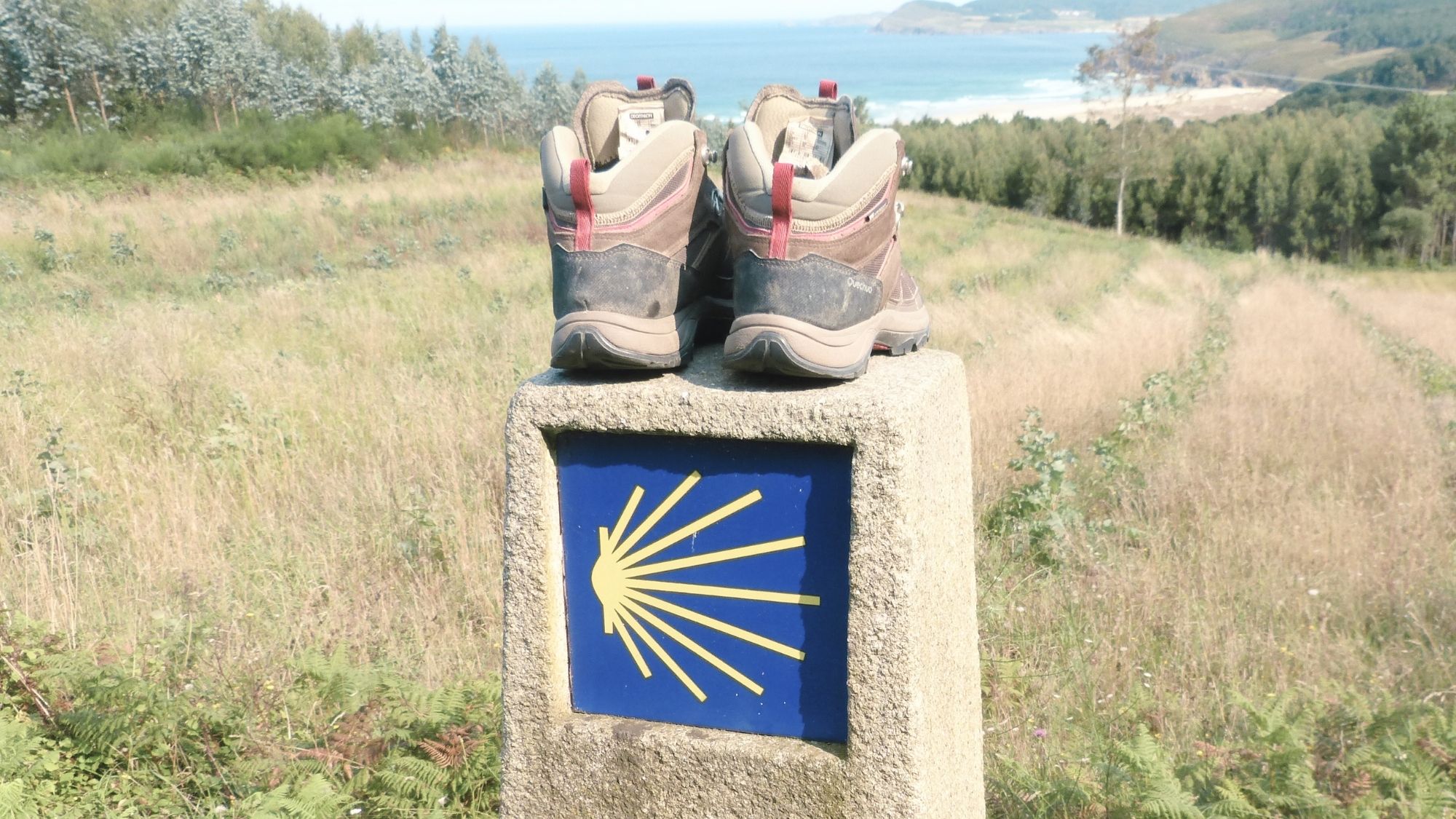
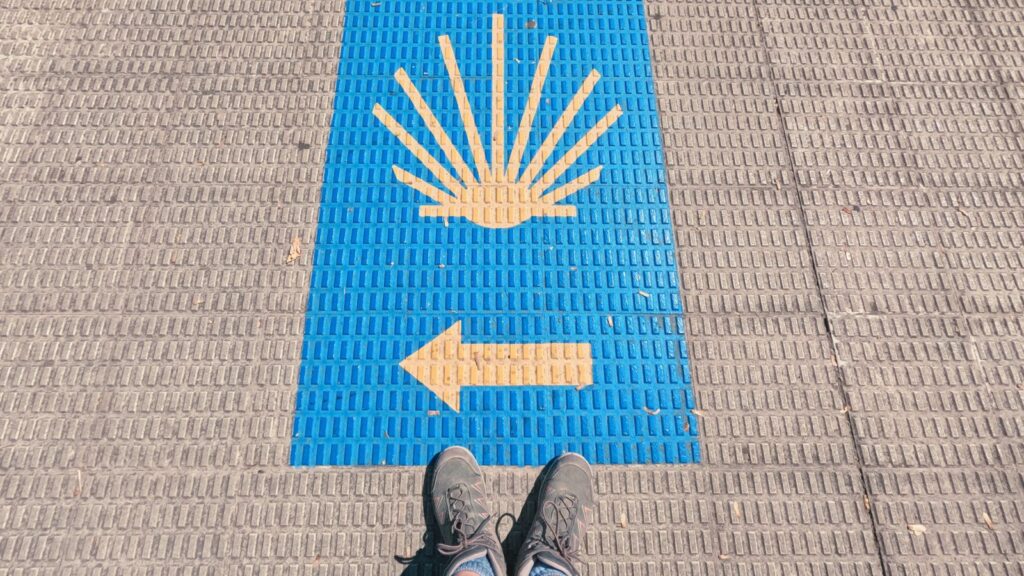
The scallop shell is the symbol of the pilgrimage. It is used frequently to waymark the route and appears on fingerposts, walls, and pavements. Shells can also be spotted dangling from backpacks and decorating walking poles, identifying those carrying them as pilgrims.
Pilgrim Hostels
A substantial infrastructure has developed along the trails to service pilgrims, including many dedicated pilgrim hostels (albergues de peregrinos). If you want to stay at one of these hostels, you need to present a document called a pilgrim passport.
Pilgrim Passport
A pilgrim passport (credencial) is a small booklet in which you collect stamps at various points on the way. It is proof of your pilgrim status and gives you access to accommodation reserved for pilgrims. The stamps (sellos) can be collected from churches, hostels, and bars.
On presentation of your pilgrim passport at the pilgrim office in Santiago (providing you have covered the minimum distance requirement), you will be eligible to receive a certificate of completion called the Compostela.
What Is It Like to Walk the Camino?
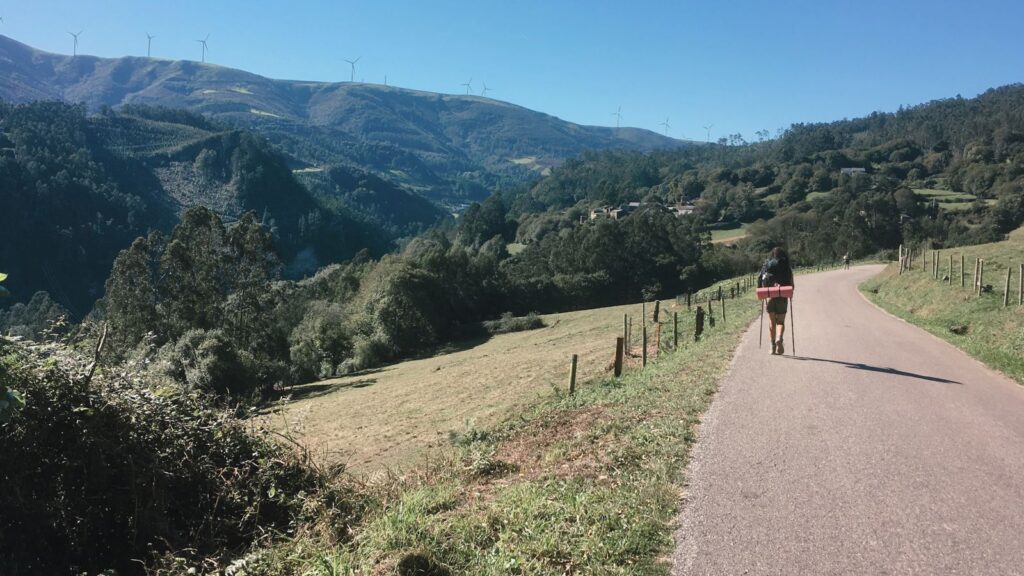
Now that you know what the Camino is, you might be wondering what it is like to walk it. Once they set off on their journey, most pilgrims discover that their days fall into a wonderfully simple routine. Mine certainly did. On my first journey on the Camino Francés my days looked something like this:
The Pilgrim Routine (A Typical Day on the Camino)
- Wake up early (5:30-6:30 am)
- Set off at 6:00-7:00 am (pilgrim hostels usually like you to leave by 8 am)
- Walk between 20 and 30 km
- Take rest stops every 5-7 km (usually 2 x coffee stops and a lunch stop)
- Check into the accommodation by early afternoon
- Shower and do laundry (usually by hand)
- Siesta
- Dinner
- Bed 8-10 pm
Your routine will vary a bit depending on which Camino you choose to walk and what time of year you decide to go. For example, walking the Camino recently in August, I often left much earlier, between 4:30 and 6:30 am to avoid the heat, as temperatures were often hitting 35-40 degrees by noon.
Keeping It Simple
However, you will find the basic structure of your days remains the same, and it is this simplicity that often attracts people to the Camino. It brings things back to basics and allows people to escape busy, and sometimes complicated, lives back home, creating the space to focus on what is most important.
Each day there is a clear goal (your destination) and a simple action to take to achieve it… just keep walking.
Finding Your Way
Route finding on the Camino routes is relatively straightforward.
The well-established trails are marked frequently with the distinctive yellow arrows painted on walls, rocks, trees, etc., along the route. There are also waymarkers at regular intervals, which usually indicate the remaining kilometres left to reach Santiago.
Although it is possible to hike most routes without the need for detailed maps, it is advisable to carry a guidebook that includes some basic maps and directions in case you miss an arrow (easily done when you are chatting to other pilgrims!). A Camino app can also be a useful route-finding tool, best used as an addition to your guidebook, as phones can often be unreliable, especially in the heat.
The Camino Community
A sense of community seems to thrive on the Camino, particularly on the Camino Francés.
Sometimes, a ‘Camino Family’ develops – where people are brought together by shared experience. Their paths may cross frequently, or they may walk multiple stretches together, sharing stories and supporting each other along the way, often resulting in lasting (and sometimes unexpected) connections.
Communal meals are offered in many albergues along the route, offering another opportunity for pilgrims to connect and share stories.
There is also a long tradition of assisting pilgrims on the Camino, so you may even find yourself on the receiving end of unexpected acts of kindness and generosity.
Want to Hike the Camino?
I hope you’ve enjoyed reading this beginners guide to the Camino de Santiago and it’s given you some inspiration to go on your own Camino adventure.
Want to know more about the main Camino routes? Check out the Mini Guides in the Camino Planning section.
If you’ve already decided you want to hike the Camino, then it’s time to start planning your pilgrimage!
Next Steps
Check out the following articles for more Camino information, practical tips and advice on how to get started:
Not sure which route to choose? Download your FREE Camino Planning Starter Pack, which includes a Routes Comparison & Distances Table plus a handy Camino Packing List.